
Historian brings Marshall County’s ghost towns to life
Trending
Communities like Marietta, Minerva, Capron, Pickering, Illinois Grove and Luray may not ring much of a bell for most locals, but nevertheless, these "ghost towns" are a crucial piece of Marshall County history with remnants such as cemeteries and townships still bearing their names all of these years later.
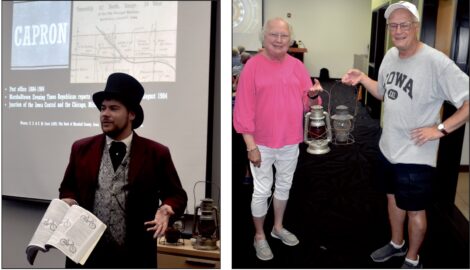
On Sunday afternoon, Iowa historian Dave Baker, who runs "The 29th State" website and Facebook page spoke to a group of about 50 people at the Marshalltown Public Library and presented on Marshall County Ghost Towns, noting that some were actually incorporated cities with post offices and businesses before they died out while others were simply clusters of homes.
Baker, of Ankeny, joked that his wife sometimes finds his desire to pull over to the side of the road to document some artifact of a long lost town "crazy," but he went on to explain why he finds his studies so important.
"What happens is, these areas and communities, even though they no longer exist, what they do is they help shape our belief system because we carry that generationally, right? We have certain assumptions that came to us from our parents, our grandparents and even, in some cases, our great grandparents," he said. "Well, there's a good chance, especially with our great grandparents, they may have been from some of these communities. Case in point, my own great-great-grandmother was born in a ghost town in Marion County."
As he worked his way through the program, Baker noted how the railroad often shaped where towns -- Capron, which was east of modern-day Melbourne, was an example -- would spring up, and he cited Rockton, located east of Marshalltown, as a "company town."
Others, like Fredonia, began as religious communities populated by the Dunkers, and Bangor was founded by Quakers.
Perhaps the most well-known ghost town of Marshall County is Marietta, located northwest of modern-day Marshalltown, as it was the original county seat before residents of Marshalltown (then known as Marshall), including town founder Henry Anson, began pushing to move the county seat here, resulting in a series of skirmishes between the residents of th two communities.
Luray, located near the modern-day intersection of Highways 30 and 330 southwest of Marshalltown, was the shortest-lived as it came into existence just before the turn of the 20th century and died out within 30 or 40 years after developing as a reputation as a "rough" town known for gambling, in Baker's words.
When he asked those in attendance if they were familiar with each community, Baker usually got at least a few "Yeahs" from the audience. Several attendees stuck around after he wrapped up his presentation to ask additional questions and share their own pieces of Iowa history, and Baker, donning his trademark suit and tophat, was happy to engage with them.
To learn more about Baker and his work, visit https://www.facebook.com/The29thState/ or http://www.iowathe29thstate.com/.
------
Contact Robert Maharry at 641-753-6611 ext. 255 or rmaharry@timesrepublican.com.