
P&Z Commission kicks off discussion on timeline for data center rules and regulations project
Trending
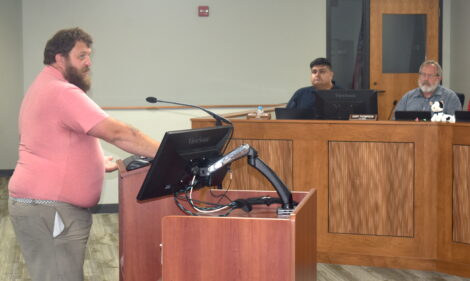
Three days after the Marshalltown city council voted 5-2 to move forward with a four-month moratorium on data center construction and referred the matter to the Planning & Zoning Commission for further review and recommendations, the latter body met at city hall Thursday night to take the first steps in the process, mostly focusing on establishing its timeline during the 45-minute discussion that also featured public input.
Assistant Housing and Community Development Director Clayton Ender, who led the discussion, asked that the conversation remain limited to the project schedule as there will be plenty of time to debate the issue of data centers themselves throughout the process. A formal resolution to establish the temporary moratorium will be on the city council agenda for July 27.
From there, Ender gave a similar presentation to the one he shared at the council meeting explaining that data centers are not specifically mentioned in the current zoning code, and the most comparable use, in his view as the zoning administrator, is a major utility, which is not permitted by right or prohibited in any zoning district within city limits. Without a moratorium in place under the current regulations, a data center project would not be subject to council approval unless the developer is requesting financial incentives, annexing land into city limits or a rezone.
One of the most controversial aspects of data centers is their heavy use of water and electricity, and Ender acknowledged that while adding that he is continuing to learn more about them. As it stands now, water and power usage are not restricted for any zoning classifications, and there are also no specific setback requirements regarding data centers now. There are, however, guidelines regarding noise -- a 50 decibel maximum from 10 p.m. to 7 a.m.
Before voting for the moratorium at the last meeting, the council had previously opposed a moratorium and opted instead to require data center companies to work with the economic development team at the Marshalltown Area Chamber of Commerce on development agreements, but Ender said such an approach was deemed "problematic" by the city's legal counsel as it could potentially be considered "arbitrary and capricious."
He then dove into the proposed schedule of events, which would culminate with the council passing three readings of the new ordinance in October and November and lifting the moratorium. The projected schedule is as follows: July 27 -- Council formally adopts moratorium resolution; Aug. 13 -- P&Z Work Session; Aug. 27 -- Community Roundtable session; Sept. 17 -- P&Z work session and review of draft regulations; Oct. 1 -- public open house; Oct. 15 -- P&Z Public Hearing and review of revised draft, and; Oct. 26, Nov. 9 and Nov. 23 -- first, second and third readings for approval by the city council.
It was quickly noted that two members of the commission will miss the meeting on Aug. 13, jeopardizing a quorum, and Chairman Jon Boston suggested moving the first work session to Aug. 6. He also felt the commission should get "a little further into" the process before the community roundtable is held, hoping to have a draft regulation ready first and invite interested parties such as representatives from Alliant Energy to provide insight.
"I think there's a lot of misconceptions about data centers," Boston said before speculating that he struggled to believe a 5,000 acre hyperscale facility would want to come to Marshalltown.
When asked what a roundtable might entail, Ender suggested inviting industry experts and utility partners to speak and called it "a brainstorming session," while an open house would be more "come and go as you please," allowing attendees to view a presentation, submit comments and leave. Commissioner Ben Harris-Medina felt both schools of thought on the timeline were fine and didn't have an issue with a rough draft being in place before the first roundtable.
Boston agreed with the idea of a work session on Aug. 6 and felt he could come back with "a very rough draft" in time for the P&Z meeting the following week.
For the last 15 minutes of the meeting, several public commenters -- many of whom had previously spoken at the city council meeting -- made their feelings known, though Ender again advised them to focus on the schedule and procedure of the project as opposed to the larger political debate over data centers. Erin Carpenter said she was encouraged by the collaborative process and hoped it would continue for the next several months, while Annie Grieshop questioned who would be asked to contribute to the draft ordinance and hoped other planning professionals besides those who are directly connected to the data center industry would be asked to participate in the conversation.
"The more information, the better, so we're always happy to hear input. I can only speak for myself, but I imagine that I'm not alone in saying I'm not an expert. So hearing input from other people who have more experience is always good and allows us to take that information, synthesize it and make good decisions for our community," Harris-Medina said.
Grieshop also asked how misconceptions surrounding data centers could be corrected and hoped the commission would be forthright in its dealings, and Ender said "everyone" should be invited and would be happy to reach out to any group that someone feels should be involved in the process. Layne Pieri expressed similar concerns about inviting industry leaders who stood to gain from data center construction without featuring opposing viewpoints as well.
"I would hope that you would consider inviting both perspectives just so the public can make their own decisions on that," Pieri said.
Tim Bradbury wanted more details on what the information gathered at data centers is being used for, and commission members reminded him that their goal was simply to recommend zoning regulations, which are still subject to city council review and approval.
"Almost everybody's got information stored on the cloud, and that's data centers. Every filling station, every grocery store, their information's all on data centers," Boston said.
It was noted that Fisher Controls formerly had a backup data center in Marshalltown before it was moved elsewhere, and in response to further comments from Grieshop, Ender explained what role the P&Z Commission plays in the regulatory process.
City Councilor Marco Yepez-Gomez repeated the concerns about Alliant being involved in the planning process because data centers are "a key driver" of the company's growth. Instead, he felt that professors and environmental advocates should be invited.
"Even at the beginning, to be blunt, it feels like we're not necessarily taking this serious," he said. "We mentioned the Emerson data center. That one is about 2 to 4 megawatts. What's happening in Cedar Rapids, they have a campus that's 1,000 megawatts, which is 250 times larger than what Emerson's data center is on Governor Road. So it's very different discussions happening this decade."
He told the commission he would only be interested in allowing smaller "enterprise" data centers in Marshalltown and did not want to see co-locations and hyperscale facilities, which Alliant would likely advocate for allowing. Boston replied that Alliant is interested in increasing its customer base, and he also hoped they would be involved because their representatives know state laws well. Ender and Harris-Medina said they would be interested in contacting representatives from the other side of the conversation and would welcome the opportunity to hear from them.
A fellow councilor, Gary Thompson, then told Yepez-Gomez that he had been advised against opining at P&Z Commission meetings by the city attorney in the past during the rewrite of the zoning code because the city council ultimately has the final say over the commission's recommendations.
"We have the final say. We shouldn't guide you to give you what you want," Thompson said.
The commission informally agreed to the original schedule with the Aug. 6 work session added.
Contact Robert Maharry at (641) 753-6611 ext. 255 or rmaharry@timesrepublican.com.