Pressman speaks on Holocaust documentary
Trending
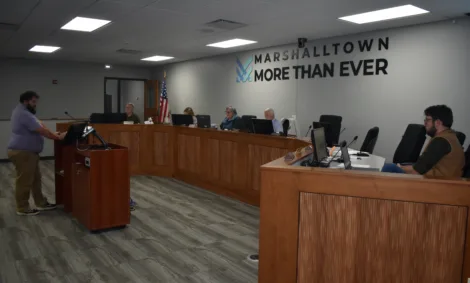
After a month of programs highlighting the history of the Holocaust, the Marshalltown Public Library (MPL) presented its final lecture tied to the traveling exhibit at Dejardin Hall on the campus of Marshalltown Community College (MCC) Thursday evening.
Steven Pressman, a documentarian, author and journalist of over 30 years, gave an informative talk about the story behind his film -- "50 Children: The Rescue Mission of Mr. and Mrs. Kraus" -- and his book -- "50 Children: One Ordinary American Couple's Extraordinary Rescue Mission into the Heart of Nazi Germany."
Both the book and documentary detail the story of Gilbert and Eleanor Kraus, a Jewish couple from Philadelphia who made the journey to Nazi Germany in 1939 to rescue 50 Jewish children from Vienna.
Pressman explained the background behind the creation of the documentary and then the book. He talked about how he found a packet of papers in his wife Liz Perle's desk drawer, detailing a story that had been forgotten for about 75 years.
"It starts with words on a page," Pressman said. "For many years, my wife Liz kept a stack of yellowing, onion skin pages tucked away, half-forgotten really in a desk drawer in our home in San Francisco. They were mixed in with a very exciting assortment of things like our bank statements, our kids' medical records, old dental bills and other equally exciting household documents, but there was nothing mundane at all about the astonishing tale that had been carefully typed out on those increasingly brittle pages."
The papers were a typed account of the rescue plan for 50 children in Germany, written by Eleanor Kraus. Mr. and Mrs. Kraus were Perle's maternal grandparents, and Pressman found that Perle's family was just vaguely aware of what the Krauses did in 1939.
Along with the packet of papers, Pressman also found a plastic bag containing more than a dozen German passports stamped with a Nazi swastika.
Even after the discovery, Pressman said it would still take him nearly a decade more before he could devote his time to spreading the story of the Krauses and the children they rescued.
"Once I began to look a little more carefully into this story, it quickly became very clear to me that this was much more than simply another Holocaust rescue account, and in fact, as I did more research into their unheralded actions, it allowed me to gain a much greater understanding of the considerable obstacles that stood in their way as they valiantly carried out their mission," he said.
Before digging deeper into the 50 children story, he spoke briefly about the antisemitism in America at the time and about how many more Jews could have been saved had certain attitudes towards immigration been different.
As he got back to Gilbert and Eleanor Kraus, Pressman asked why this particular couple would be invested in this cause. The couple were well off, and while they were Jewish, Pressman said they were not religious Jews and weren't the types to go to the synagogue on holidays.
The explanation was a fraternal organization that Gilbert was a member of, B'rith Sholom, which had agreed to participate in a plan to rescue 50 German children, and a friend of Gilbert's came to him and asked him to take charge of the difficult task.
"We can all probably imagine (Eleanor's) reaction that night that her husband Gil comes home from the office in January of 1939 and just sort of casually mentions to his wife this idea of going to Nazi Germany in order to bring back a group of Jewish children," Pressman said.
Pressman played a clip of a person reading out a comment from Eleanor where she expressed her doubts and her safety concerns. Despite these reservations, her husband Gilbert sailed to Europe weeks later to embark on the mission along with Dr. Robert Schless, a prominent Philadelphia pediatrician who was both a family friend and could speak fluent German.
Initially, Eleanor stayed behind, as she had been advised by a state department official that Germany was not a safe place for a woman to be traveling in at the time, either accompanied or unaccompanied by her husband. Just a few weeks after Gilbert and Schless left, however, Eleanor joined them.
"Gil knew that time was of the essence, he knew how much work they had to do once they got into Germany. He sent a cable to his wife and said, 'Please come, there's a ship leaving, I would like you to be on that ship,' and so she went," Pressman said.
The 50 children were the single largest group of unaccompanied minors brought back to the United States at once during the entirety of the Holocaust.
Pressman said there is a myth that people may have been more likely to help Jews in Europe during the Holocaust if only they had known about the atrocities occurring. Conversely, the Krauses were just average American citizens who were well informed and read the newspapers filled with stories of the brutal acts against Jews in Germany.
"Perhaps the question that I described earlier isn't why Gil and Eleanor Kraus did what they did. Perhaps the more important question, and I think the one that haunts a lot of us to this day, is why there weren't many more people like them?" Pressman asked.
He said rigid immigration laws made bringing large groups of Jews to the United States difficult.
Pressman briefly discussed a bill under consideration at the time called the Wagner/Rogers Act which would have allowed up to 20,000 German Jewish children to come to the United States. It was tabled by President Franklin Delano Roosevelt and never made it to the floor of the House or Senate.
In conclusion, Pressman said because the Krauses were just two normal Americans, their accomplishment was all the more heroic.
"Each and every one of us ultimately possesses the capacity to save the world, not the entire world, but one life at a time. One righteous act at a time, even one very, very small deed at a time, no matter how seemingly insignificant it is," Pressman said. "After all these years, I still think of Gil and Eleanor Kraus as two ordinary Americans who I don't think for a second would have thought of themselves as heroes."
After Pressman's talk, he held a book signing. While his presentation was the last event on the Holocaust that the MPL is hosting, the Americans and the Holocaust exhibit will still be available to view at the library until noon on May 6.
------
Contact Susanna Meyer
at 641-753-6611 or
smeyer@timesrepublican.com.